
Climatisation pour Appartement en Belgique : Confort, Économie et Qualité de l’Air
/0 Comments/in blog /by webdono19With summers becoming increasingly hot and winters sometimes harsh, air conditioning is becoming an essential solution for ensuring optimal thermal comfort in flats in Belgium. Whether you want to cool your space in summer or improve the efficiency of your heating in winter, a well-chosen air conditioning system can be an excellent investment.
In addition to providing comfort, good air conditioning also helps control humidity, improve air quality and reduce certain nuisances such as unpleasant odours or the proliferation of bacteria and mould. What’s more, installing an air conditioning system can be a considerable asset in increasing the value of your property.
In this article, we will explore the advantages of air conditioning for flats in Belgium, the different types of installations available, the criteria to consider before purchasing, the regulations in force, and some practical tips for optimising its use on a daily basis.
Why Install Air Conditioning in an Apartment in Belgium?
- Optimal comfort in all seasons
Air conditioning does more than just cool your home. Recent models also offer a heating function (air-to-air heat pump), allowing you to maintain a comfortable temperature throughout the year. In winter, this type of air conditioning can supplement your central heating, reducing your energy consumption and improving your overall comfort.
- Better air quality
Modern air conditioners often incorporate filters capable of capturing dust, pollen, allergens and other airborne particles. Some models even feature advanced purification systems that eliminate bacteria and viruses, ensuring healthier air inside your flat. This can be particularly beneficial for people suffering from allergies, asthma or respiratory problems.
- An economical energy solution
Modern air conditioning systems are designed to be energy efficient. A heat pump can reduce your heating consumption in winter by capturing heat from outside and distributing it inside. In addition, with advances in technology, new air conditioners consume much less electricity than before. By using reversible air conditioning, you can reduce your energy bill by optimising the thermal management of your home.
- Increasing the value of your property
An air-conditioned flat can be more attractive on the property market, whether for rental or resale. Buyers and tenants are increasingly looking for homes that offer good thermal comfort. Installing a modern, energy-efficient air conditioner can therefore be a real asset when selling or renting out your property.
- Precise temperature control
Thanks to new technologies, today’s air conditioners offer precise temperature control, with smart features such as remote programming via a mobile app, presence sensors and eco modes that automatically adjust consumption based on room usage.
The Different Types of Air Conditioning for Apartments
Before installing an air conditioning system in your flat in Belgium, it is essential to be aware of the various options available.
- Monobloc air conditioning
- Ideal for small spaces
- Simple installation without an external unit
- Less effective at cooling multiple rooms
- Higher noise level compared to split systems
A Climatisation Monobloc is a type of air conditioning system where all the components—such as the compressor, condenser, and evaporator—are housed in a single unit. Unlike traditional split air conditioning systems, where the components are divided into an indoor and an outdoor unit, a Monobloc system is compact and typically placed inside the room it is cooling.
These systems are often more convenient for smaller spaces or for people who don’t want to go through the hassle of installation for split systems. They can be portable or fixed, and they often come with a venting option to expel heat outside. However, they may not be as energy-efficient as split systems and can be noisier due to the compactness of the unit.
- Split air conditioning
- Comprising an indoor unit and an outdoor unit
- Quiet and efficient
- Requires authorisation to install the outdoor unit in a condominium
- Can be equipped with air purification technologies
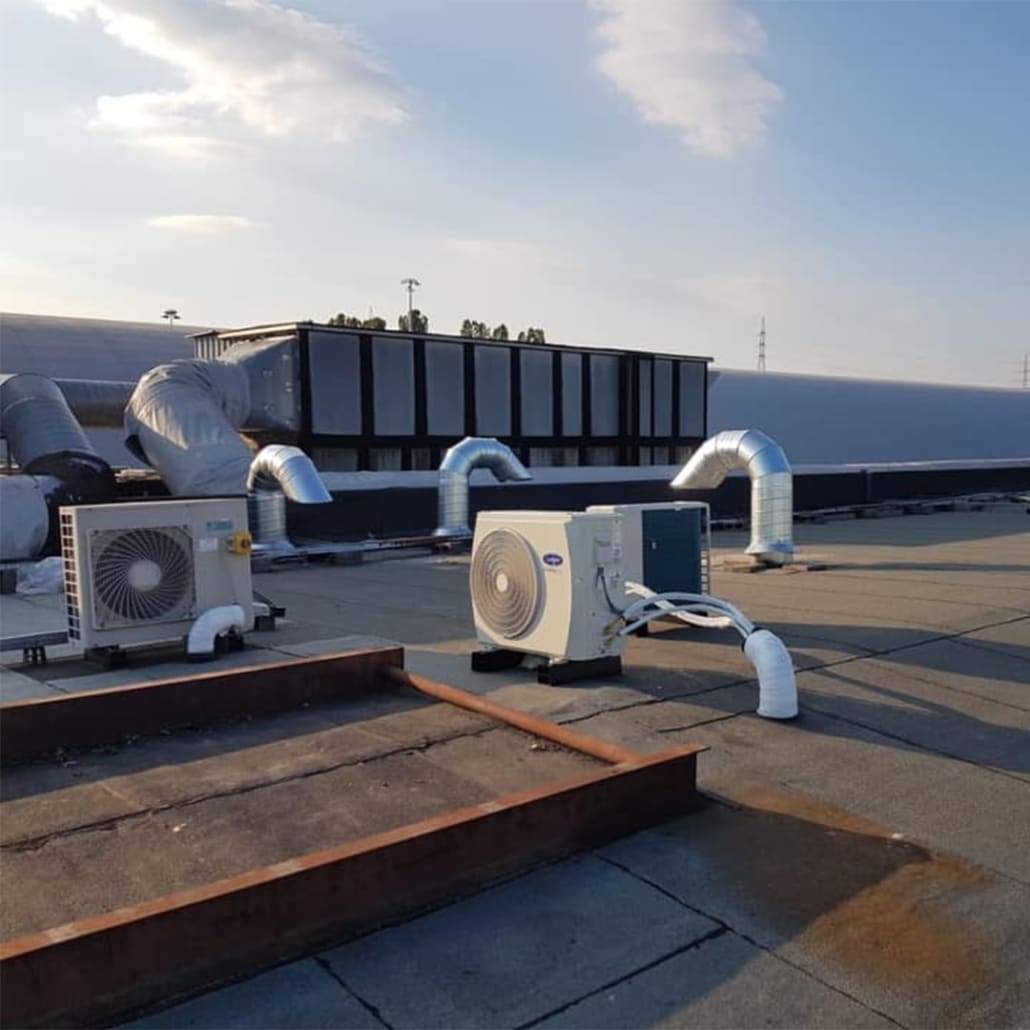
A Climatisation Split (or Split Air Conditioning system) is a type of air conditioning system that consists of two separate units: an indoor unit and an outdoor unit. The two units are connected by refrigerant pipes and electrical wiring, with the indoor unit placed inside the room being cooled and the outdoor unit installed outside the building. This split design allows for better efficiency and performance compared to monobloc units.
The indoor unit is the part that cools (or heats) the air inside the room. It contains the evaporator coil and a fan to blow cooled air into the space. It’s typically mounted on the wall or ceiling. The outdoor unit is located outside the building and houses the compressor, condenser coil, and fan. Its main function is to expel the heat from the indoor air, turning the refrigerant back into a gas to release the heat outside. The refrigerant lines are the pipes that carry the refrigerant between the indoor and outdoor units, allowing for heat transfer and cooling.
A Climatisation Split system is generally more energy-efficient than monobloc systems, as the compressor (which uses a lot of power) is located outside, keeping the indoor unit quieter and reducing power consumption. It offers better cooling performance, as the outdoor unit is specifically designed for heat dissipation, allowing the system to cool larger spaces more effectively. The system operates quietly, as the compressor is located outside, and the indoor unit is often sleek and can be mounted in a variety of locations, making it less obtrusive. These systems can also support multiple indoor units connected to a single outdoor unit, providing a multi-zone solution.
However, the split system comes with higher installation costs, as it requires professional installation, including the mounting of the outdoor unit and the installation of refrigerant lines. It also requires space outside the building for the outdoor unit, which may not be suitable for all environments. In summary, a Climatisation Split system is a highly efficient, quiet, and versatile air conditioning option, ideal for larger spaces or situations where performance and aesthetics are important.
- Climatisation Multi-Split
- Allows you to air condition multiple rooms with a single outdoor unit
- Ideal for large flats
- Higher installation cost
- Adaptable to specific requirements
A Climatisation Multi-Split system is an advanced version of the traditional Climatisation Split system. It consists of one outdoor unit connected to multiple indoor units. This setup allows for cooling or heating multiple rooms or zones within a building using a single outdoor compressor. Each indoor unit can be controlled independently, offering flexibility in temperature regulation for different rooms.
The indoor units in a multi-split system are typically mounted on walls or ceilings and can vary in design, allowing for a combination of different styles and capacities based on the room’s needs. These units are connected to the outdoor unit via refrigerant lines, just like in a regular split system, but the outdoor unit is designed to handle multiple indoor units.
A Climatisation Multi-Split system provides significant advantages over using several individual split systems. It saves space by consolidating the outdoor components into a single unit, which is particularly useful for buildings with limited outdoor space. Additionally, it can reduce installation costs and simplify the setup process compared to installing multiple separate units. Each indoor unit can be controlled independently, allowing users to set different temperatures for each room, offering customized comfort throughout the building.
Despite these advantages, multi-split systems can have some limitations. The total cooling or heating capacity depends on the capacity of the outdoor unit and how many indoor units are connected to it. If too many units are added, it may overload the outdoor system, reducing efficiency. Furthermore, installation can still be complex and may require professional expertise, especially when dealing with multiple indoor units.
In summary, a Climatisation Multi-Split system is an efficient and flexible solution for cooling or heating multiple rooms with one outdoor unit. It combines the benefits of a split system with the added convenience of controlling different areas independently, making it ideal for larger homes, offices, or buildings with several rooms that need varying temperature settings.
- Reversible Air Conditioning (Air-to-Air Heat Pump)
- Heating and air conditioning function
- Energy-efficient solution
- Can replace conventional heating
- Highly effective for regions with mild winters
A Climatisation Réversible (reversible air conditioning system) is an air conditioning unit that can both cool and heat a space, offering year-round climate control. This system works by using a heat pump, which allows the unit to reverse the flow of refrigerant. In cooling mode, the refrigerant absorbs heat from inside the room and expels it outside. In heating mode, the process is reversed: the system absorbs heat from the outside air and releases it inside, warming the room.
The key advantage of a Climatisation Réversible system is its versatility. During the warmer months, it functions as a standard air conditioner, providing cooling to maintain a comfortable indoor temperature. In colder months, it switches to heating mode, offering an energy-efficient alternative to traditional heating systems like electric heaters or gas boilers.
This system is efficient because it moves heat rather than generating it. The process of transferring heat from one location to another consumes less energy compared to systems that create heat from scratch, making it more cost-effective and environmentally friendly than using separate units for cooling and heating. It also tends to be quieter and more compact than traditional heating systems.
However, a Climatisation Réversible system may be less effective in extremely cold climates, as the outdoor air may not contain enough heat for the heat pump to function efficiently. Some models also require additional components, like an auxiliary electric heater, to provide adequate heating when temperatures drop very low.
In summary, a Climatisation Réversible system is a two-in-one solution that provides both cooling and heating, making it an efficient and flexible option for year-round comfort in residential or commercial spaces.
Criteria for Choosing Air Conditioning for an Apartment
- The Surface Area to be Air-Conditioned
The power of your air conditioner must be carefully selected based on the size of your flat to ensure optimal efficiency. If the unit is too small for the size of the space, it will struggle to cool or heat the room evenly, resulting in excessive energy consumption in an attempt to compensate for this shortfall. Conversely, a unit that is too powerful for the size of your flat will tend to consume more energy than necessary. Although this may initially seem beneficial, it will only increase your electricity bill without actually improving comfort. It is therefore crucial to find a balance based on the size of the flat to ensure efficient and energy-efficient operation.
- The Sound Level
In an apartment, it is essential to choose a quiet air conditioning model, especially if the unit is installed in rooms where peace and quiet are paramount, such as a bedroom or living room. A noisy air conditioner can affect your comfort, disturbing your sleep or tranquillity, particularly during summer nights or when you are relaxing. A quiet model, on the other hand, allows you to enjoy a pleasant atmosphere without any noise distractions. What’s more, with modern technology, many models are designed to operate almost silently, ensuring a more pleasant air conditioning experience while maintaining optimal performance.
- Energy Consumption
Il est important de vérifier l’étiquette énergétique du climatiseur avant de faire votre choix. Les modèles avec un bon classement énergétique, comme A++ ou A+++, sont conçus pour offrir une performance optimale tout en réduisant la consommation d’électricité. Opter pour un climatiseur avec un tel classement vous permet de réaliser des économies d’énergie sur le long terme, tout en réduisant l’impact environnemental de votre consommation d’énergie. De plus, un modèle économe en énergie vous aide à maintenir des factures d’électricité plus basses, tout en offrant une efficacité de refroidissement ou de chauffage comparable à des appareils moins économes.
- Ease of Installation
Some air conditioning systems require more complex installation work, particularly those involving an outdoor unit, such as split or multi-split systems. These installations may require adjustments to the structure of the flat or external modifications to install the unit. Before choosing a model, it is crucial to find out about the regulations of your condominium or building, as certain rules may limit the installation of an outdoor unit due to aesthetic, safety or noise constraints. Be sure to obtain the necessary authorisation to avoid legal complications or additional installation costs.
- Additional Features
Some air conditioners offer advanced features that can improve comfort while optimising energy consumption. For example, smartphone control allows you to manage the temperature of your flat remotely, giving you more flexibility and the ability to pre-set the temperature before you arrive. In addition, eco modes are often built in, reducing energy consumption by automatically adjusting settings based on room temperature and usage. Some models also include presence detectors that detect whether someone is in the room and adjust the air conditioning accordingly, thus avoiding unnecessary operation of the unit. These options not only improve energy efficiency, but also offer you personalised comfort according to your needs and lifestyle.
Tips for Optimising the Use of Your Air Conditioning
1. Selecting the Ideal Temperature
Set your air conditioner to a reasonable temperature. An excessive difference with the outside temperature can lead to overconsumption. The recommended temperature is generally between 24 and 26°C for optimal comfort. Avoid setting your air conditioner too low, as this forces the unit to run continuously, thereby increasing electricity consumption. In addition, too great a difference with the outside temperature can cause thermal shock when moving around.
2. Close Doors and Windows
To prevent cool air from escaping, make sure you close doors and windows when your air conditioner is running. This also prevents hot air from outside from entering, thereby optimising the efficiency of your appliance. Also remember to insulate your home properly: double-glazed windows and well-fitted seals help to limit heat exchange and improve the energy efficiency of your air conditioner.
3. Use Curtains and Shutters
During the day, close curtains and shutters to limit direct exposure to sunlight. This reduces the amount of heat entering the room and decreases the workload on the air conditioner. Opt for thermal curtains or reflective blinds that help reduce heat build-up. In addition, painting exterior walls with light colours can also help reduce heat absorption.
4. Maintain the Device Regularly
Regular maintenance extends the life of your air conditioner and improves its performance. Clean or replace the filters every month and have the entire system checked by a professional at least once a year. A dirty filter reduces air circulation and forces the unit to work harder, which increases energy consumption. Also remember to clean the outdoor units to prevent dust and leaves from blocking the unit’s proper functioning.
5. Use Eco Mode or Programmable Mode
If your air conditioner has an economy or programmable mode, use it to regulate the temperature according to your presence in the room. This saves energy without compromising your comfort. For example, programme your unit to run at a slightly higher temperature at night or when you are away, then gradually lower it before you return.
6. Ventilate the Room Naturally
When the outside temperature is cooler, such as early in the morning or late at night, turn off the air conditioning and open the windows to refresh the indoor air and cool your space naturally. Good air circulation reduces the need for constant air conditioning and improves indoor air quality.
7. Avoid Heat Sources
Appliances such as ovens, hobs and incandescent light bulbs generate a lot of heat. Try to limit their use during the hottest hours of the day so as not to overload your air conditioning. Replace your conventional light bulbs with LED bulbs, which give off less heat and consume less energy.
8. Invest in an Efficient Air Conditioning System
Si votre installation est ancienne et énergivore, envisagez de la remplacer par un modèle plus récent et performant. Les climatiseurs de classe énergétique A++ ou A+++ offrent un meilleur rendement tout en consommant moins d’énergie. Optez pour une climatisation réversible qui permet de chauffer en hiver et de rafraîchir en été, optimisant ainsi l’investissement sur le long terme.
9. Use a dehumidifier
Sometimes, thermal discomfort is caused by excessive humidity rather than excessive temperature. In this case, using a dehumidifier can be an effective alternative to reduce ambient humidity and make the temperature more bearable without necessarily lowering the thermostat on your air conditioning.
10. Supplement with fans
Using fans in addition to air conditioning helps to distribute cool air more evenly throughout the room. A ceiling fan, for example, helps to circulate the air and optimise the distribution of cool air. This allows you to increase the temperature setting on your air conditioner by a few degrees without compromising on thermal comfort.
Installing air conditioning in an apartment in Belgium has many advantages, both in terms of comfort and energy efficiency. By choosing a model suited to your needs and following a few best practices, you can enjoy a comfortable indoor environment all year round while keeping your energy consumption under control.
At Frigotec, we assist you in choosing and installing your air conditioner, offering you high-performance, cost-effective solutions. Contact us for a personalised quote and enjoy optimal thermal comfort all year round!


Leave a Reply
Want to join the discussion?Feel free to contribute!