
Energy Transition and Refrigeration: How Belgian Businesses Are Adapting to New F-Gas Regulations
/0 Comments/in blog /by webdono19a new era for refrigeration in Belgium, professional refrigeration is central to the operation of many businesses in Belgium, whether supermarkets, restaurants, hotels or food laboratories. But with the new F-Gas regulations, which aim to reduce the environmental impact of fluorinated gases, the refrigeration sector faces a major turning point. The energy transition and refrigeration is no longer an option, but a necessity for all Belgian businesses concerned with sustainability and regulatory compliance.
The energy transition and refrigeration involves a rethinking of traditional practices, from acquiring new equipment to optimizing existing systems, and training staff. Through this article, Frigotec, a specialist in professional refrigeration in Belgium, guides you to understand the challenges of the energy transition and refrigeration and discover how Belgian businesses are successfully adapting to the new F-Gas standards.

Understanding F-Gas Regulations and Their Impact on Refrigeration
F-Gas regulations, established by the European Union, aim to reduce the use of fluorinated greenhouse gases (HFCs) in refrigeration and air conditioning systems. These gases, long used for their energy efficiency, contribute significantly to global warming.
A. Objectives of F-Gas Standards
The main objectives of the F-Gas regulation are:
- Gradually reduce the quantity of HFCs used in refrigeration installations.
- Encourage the switch to more environmentally friendly alternatives, such as R290 or natural CO₂.
- Ensure that existing installations are properly maintained and monitored to limit leaks.
For Belgian businesses, this means that every professional refrigerator, cold room, or air conditioning system must be evaluated and, if necessary, adapted to comply with these standards. Frigotec supports its clients in this process by offering solutions that comply with F-Gas regulations while optimizing energy performance.
B. Implications for Belgian Businesses
F-Gas compliance can have several consequences:
- End of installations using HFCs with high warming potential.
- Investment in more ecological and more energy-efficient equipment.
- Staff training to handle new gases and technologies.
- More rigorous maintenance, with leak and performance monitoring.
Thus, the energy transition and refrigeration becomes a strategic project and no longer just a regulatory imperative.
The Energy Transition and Refrigeration: An Economic and Ecological Challenge
While Belgian businesses sometimes perceive F-Gas regulations as a constraint, they actually represent a major opportunity. The energy transition and refrigeration offers both financial and environmental benefits.
A. Reduction in Energy Consumption
New refrigeration equipment, designed to meet F-Gas standards, is often much more energy-efficient. Frigotec’s professional refrigerators and cold rooms, for example, use ventilated cooling systems and high-efficiency compressors, allowing for electricity consumption reduction of up to 40%.
This optimization directly contributes to business profitability, as energy costs represent a significant portion of operating expenses. Thus, the energy transition and refrigeration makes it possible to reconcile economic performance and environmental respect.
B. Reduction of Carbon Footprint
By replacing HFCs with natural gases with low environmental impact (R290, R600a, CO₂), refrigeration actively contributes to the fight against climate change. Frigotec is committed to providing sustainable solutions for its Belgian clients, ensuring minimal environmental impact while guaranteeing optimal product preservation.
C. Enhancing Company Image
Belgian consumers are increasingly sensitive to ecological practices. A company that invests in the energy transition and refrigeration can strengthen its brand image, attract eco-responsible customers, and differentiate itself in a competitive market.
Adapting Existing Systems to the Energy Transition and Refrigeration
Not all businesses can replace their installations overnight. The energy transition and refrigeration often involves a gradual adaptation of existing systems.
A. Audit and Diagnosis of Installations
Frigotec conducts comprehensive audits of existing refrigeration systems:
- Verification of fluorinated gas leaks.
- Evaluation of equipment energy efficiency.
- Identification of components to be replaced to comply with F-Gas regulations.
This audit is an essential step in developing a realistic and cost-effective transition plan.
B. Modernization and Conversion
Refrigeration systems can often be modernized without being completely replaced:
- Conversion of existing equipment to use natural refrigerant gases.
- Installation of high-efficiency compressors and low-consumption fans.
- Integration of intelligent control systems for continuous temperature and leak monitoring.
These actions ensure compliance with F-Gas standards while extending the lifespan of installations.
C. Proactive Maintenance and Monitoring
The energy transition and refrigeration requires regular monitoring:
- Periodic verification of gas levels.
- Inspection of seals, lines, and compressors.
- Installation of remote monitoring systems to anticipate problems.
Frigotec offers tailored maintenance contracts, ensuring regulatory compliance and optimal long-term performance of installations.
Investing in Innovative Equipment for the Energy Transition and Refrigeration
For Belgian businesses wishing to go further, the best strategy remains investment in innovative equipment designed for the energy transition and refrigeration.
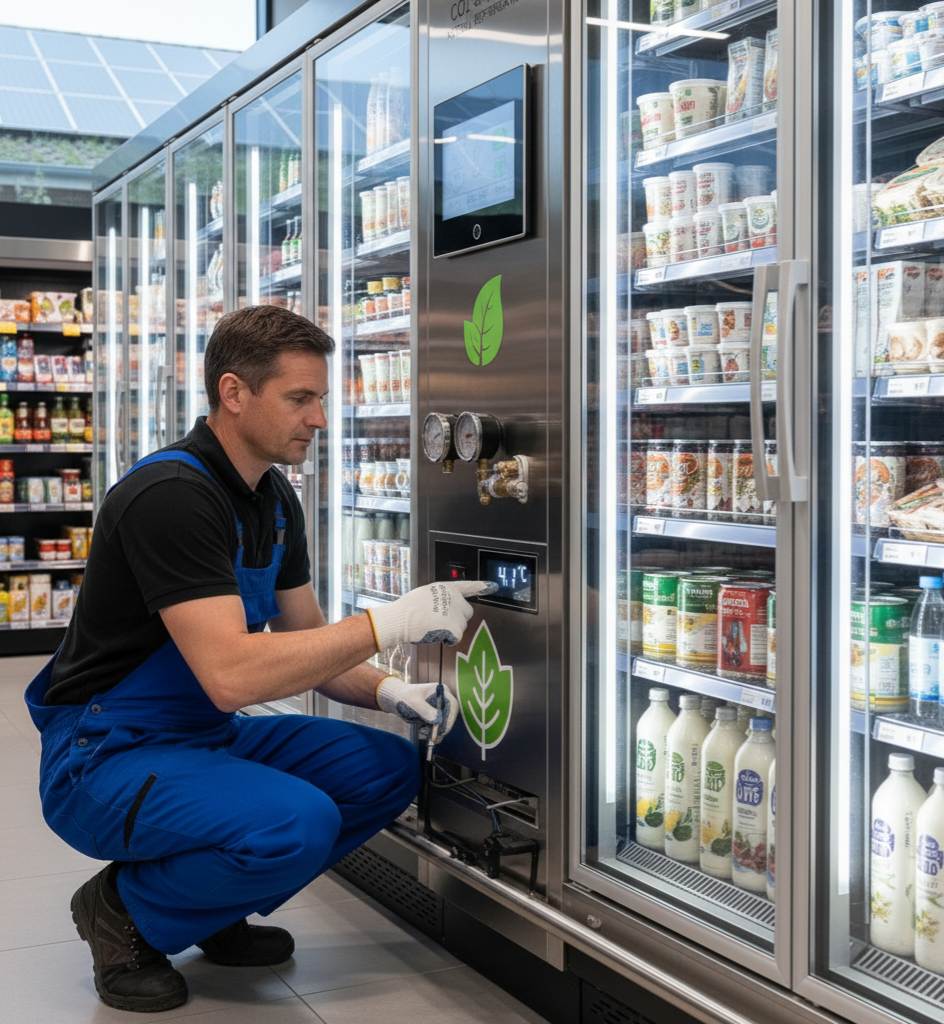
A. Eco-Responsible Professional Refrigerators
Frigotec offers professional refrigerators using:
- Natural refrigerant gases (R290, CO₂).
- Ventilated cooling systems for uniform temperature and energy savings.
- Glass doors with reinforced insulation to limit cold loss.
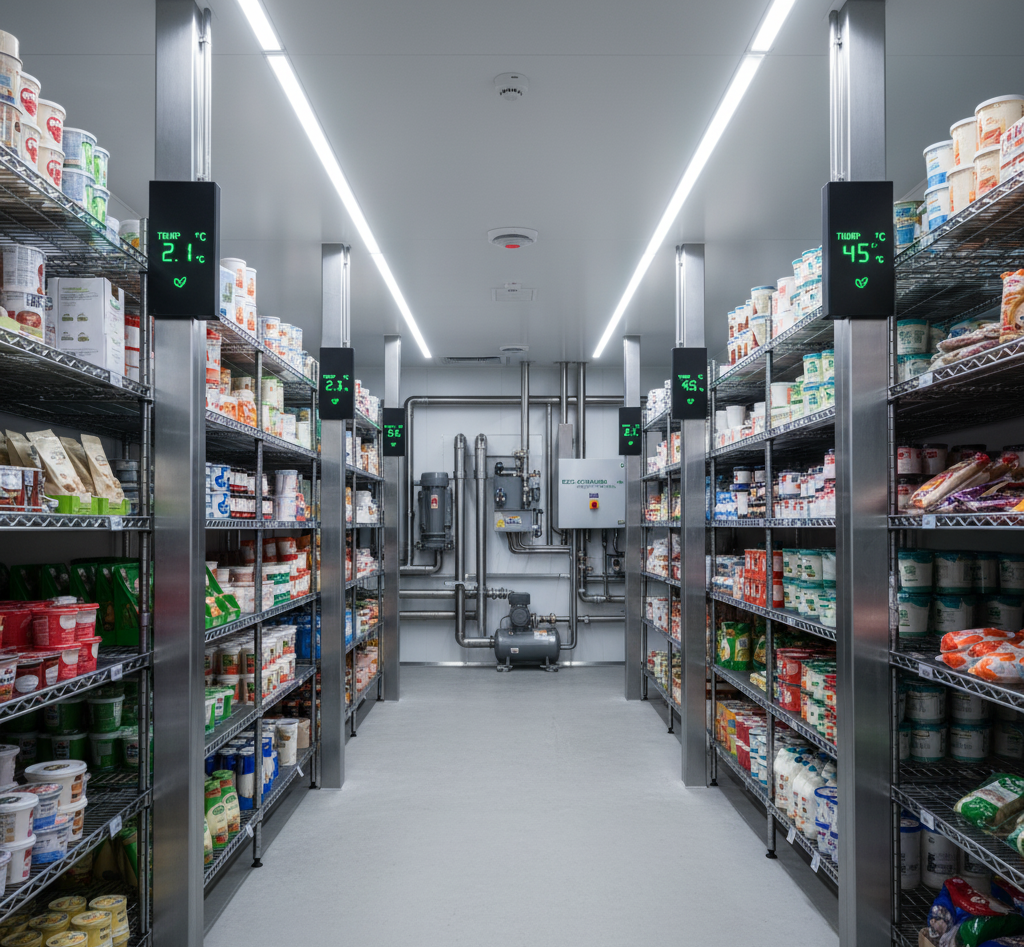
B. Low Environmental Impact Cold Rooms
Cold rooms designed for the energy transition and refrigeration allow for:
- Optimal preservation of fresh and frozen products.
- Reduced energy consumption thanks to reinforced insulation and high-efficiency compressors.
- Precise temperature and humidity control, essential for guaranteeing product quality.
C. Connected and Smart Systems
Innovation in refrigeration now includes connected cooling:
- Remote temperature control via smartphone or tablet.
- Real-time alerts in case of temperature variation or gas leak.
- Complete performance history to anticipate maintenance needs.
These technologies are essential for successful energy transition and refrigeration, as they enable proactive and efficient management of installations.
Benefits of the Energy Transition and Refrigeration for Belgian Businesses
Investing in the energy transition and refrigeration is not only a regulatory obligation, but also a lever for business performance.
A. Reduction in Operating Costs
Modern systems consume less electricity, require less maintenance, and reduce product losses. This represents significant long-term savings.
B. Guaranteed Regulatory Compliance
By adopting the solutions offered by Frigotec, Belgian businesses are assured of complying with F-Gas regulations and avoiding penalties related to infringements.
C. Ecological and Commercial Value
Clients and partners appreciate businesses that adopt responsible practices. The energy transition and refrigeration thus becomes a strong marketing argument, strengthening the company’s credibility and attractiveness.
Case Studies of Belgian Businesses and Energy Transition and Refrigeration
A. Supermarkets and Hypermarkets
A Brussels supermarket replaced its HFC refrigerators with R290 display cases supplied by Frigotec. Result:
- Electricity consumption reduced by 35%.
- Significant reduction in carbon footprint.
- Full compliance with F-Gas regulations.
B. Restaurants and Caterers
A chain of restaurants in Wallonia modernized its cold rooms with connected systems and natural gases:
- Remote temperature control and instant alerts.
- Predictive maintenance, reducing intervention costs by 20%.
- Improved quality of products served to customers.
C. Food Laboratories
Belgian food laboratories benefit from the energy transition and refrigeration to:
- Ensure the integrity of sensitive samples and products.
- Strictly comply with sanitary and F-Gas standards.
- Reduce energy consumption in critical installations.
The energy transition and refrigeration, an essential investment, and also the energy transition and refrigeration represents a major challenge for Belgian businesses, but it also offers new opportunities. Thanks to innovative equipment, connected systems, and partners like Frigotec, it is possible to comply with F-Gas regulations, reduce energy costs and environmental footprint, improve the performance and durability of installations, and enhance brand image with clients and partners.
In Belgium, businesses that adopt the energy transition and refrigeration now are placing themselves at the forefront of a sustainable and competitive sector, ready to meet tomorrow’s demands. Frigotec, with its expertise and personalized support, remains the partner of choice for successfully achieving this strategic and indispensable transition.


Leave a Reply
Want to join the discussion?Feel free to contribute!