
The most common mistakes when using a cold room (and how to avoid them)
/0 Comments/in Airconditioning, blog /by webdono19 Cold rooms are an essential tool in many sectors, including catering, hospitality, food service, agri-food industries, and healthcare facilities. They allow products to be stored at the right temperature to ensure their freshness, quality, and, above all, food safety.
However, improper use or a lack of rigor in managing a cold room can have significant consequences: food waste, excessive energy consumption, contamination risks, and costly breakdowns.
In this article, we will review the most common mistakes made when using a cold room, and above all, see how to avoid them with simple and effective solutions.
2. Poor temperature management
Common mistake
Many users set their cold rooms to an inappropriate temperature or do not check regularly to ensure that the temperature is being maintained. Sometimes the temperature is too high, promoting bacterial growth; other times it is too low, causing certain products to freeze unintentionally.
Conséquences
Health risks associated with the proliferation of microorganisms.
Degradation of food quality (loss of taste, altered texture).
Financial losses due to foodstuffs that have become unfit for consumption.
How can this error be avoided?
Strictly adhere to the storage standards specific to each type of product (e.g., +2°C to +4°C for meat, 0°C to +2°C for fish, etc.).
Install a reliable control thermometer and check the temperature readings several times a day.
Install an alarm or automatic recording system to anticipate any abnormal variations.
3. Opening the door too frequently or for too long
Common mistake
In many establishments, users open the cold room door too often or leave it ajar during handling. This bad habit, although commonplace, directly compromises the efficiency of the refrigeration system.
Conséquences
Loss of cold: each time the door is opened, warm, humid air enters.
Condensation and frost: promote ice formation on the evaporator.
Excessive energy consumption: the compressor must work harder to restore the temperature.
Health risk: products do not remain at a stable temperature.
How can this error be avoided?
Organize storage: know in advance what you need to take out or put away to limit the time you spend opening the door.
Train staff: remind them of the importance of closing the door immediately after each use.
Install a PVC strip curtain or an automatic closing system to limit cold air loss.
Equip the room with an audible alarm in case the door is not properly closed.
4. Improper storage of products
Common mistake
Many users fill their cold rooms without following any logical order: products are placed directly on the floor, boxes are stuck to the walls, or excessive storage prevents cold air from circulating properly.
Consequences
Poor distribution of cold air: some areas remain too warm, while others are too cold.
Cross-contamination: direct contact between raw and cooked products.
Food spoilage: mold, deterioration of taste and texture.
Loss of energy efficiency: the system must compensate for the lack of air circulation.
How can this error be avoided?
Respect ventilation spaces: do not stick products against walls or the evaporator.
Apply the FIFO (First In, First Out) method to avoid storing expired products.
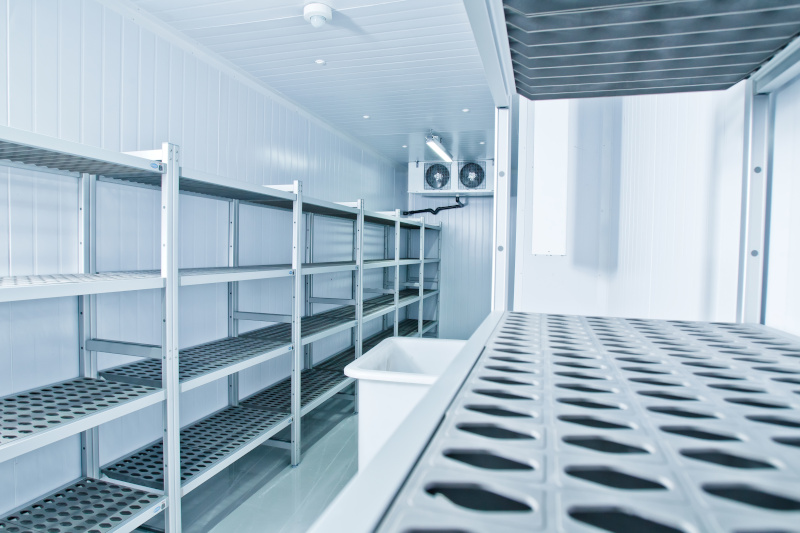
Use suitable stainless steel shelves for hygienic storage and optimal air circulation.
Clearly separate raw, cooked, and packaged products to avoid contamination.
5. Neglecting regular maintenance
Common mistake
Many companies use their cold rooms without a specific maintenance plan. Cleaning is sometimes done superficially, and technical maintenance (filters, door seals, evaporator, condenser) is often postponed.
Consequences
Frequent breakdowns: accumulation of dust and frost that blocks the system.
Increased energy consumption: dirty equipment works harder.
Health risks: mold, bacteria, and unpleasant odors develop.
Reduced service life of the installation, resulting in early replacement costs.
How can this error be prevented?
Draw up a maintenance schedule: weekly cleaning of surfaces and monthly inspection of technical components.
Regularly check the condition of the door seals and replace them if they are damaged.
Defrost the cold storage room as soon as a layer of ice begins to form.
Call in a specialist technician for a full service at least once a year.
6. Ignoring safety and traceability instructions
Common mistake
Some users simply check the temperature “by eye” or irregularly, without implementing rigorous monitoring. Others do not comply with HACCP (Hazard Analysis Critical Control Point) rules, which are mandatory in many sectors.
Consequences
Lack of traceability: in the event of a health inspection, it is impossible to prove that temperatures have been complied with.
Risk of food poisoning due to improper storage.
Regulatory sanctions: fines, administrative closure, or loss of quality certifications.
How can this error be avoided?
Set up an automatic recording system (data logger, connected sensors).
Keep a paper or digital record with daily temperature readings.
Train staff in HACCP procedures and regularly remind them of their importance.
Verify that the equipment complies with European food safety standards.
7. Installing the cold room in an unsuitable environment
Common mistake
Some cold rooms are installed in poorly ventilated areas, too close to a heat source (kitchen, oven, boiler), or in damp rooms. This choice of location compromises their proper functioning from the outset.
Consequences
Premature engine wear: it must constantly compensate for external heat.
Excessive energy consumption: increase in electricity bills.
Reduced efficiency: inability to maintain a constant temperature.
Increased risk of failure: due to overheating or humidity.
How can this error be avoided?
Choose a well-ventilated location, away from direct heat sources.
Check that the room has good air circulation around the refrigeration unit.
Avoid excessively humid environments that promote corrosion.
Call in a qualified professional to carry out the installation to ensure compliance with standards.
8. Underestimating staff training
Common mistake
Even if the cold room is well installed and properly equipped, its effectiveness depends above all on the people who use it on a daily basis. Too often, staff are not trained in good practices: opening the door unnecessarily, disorderly storage, failure to record temperatures, or neglecting hygiene instructions.
Consequences
Repetition of common errors, despite high-performance equipment.
Food waste due to improper handling.
Health non-compliance in the event of an inspection.
Financial losses due to poor inventory management.
How can this error be avoided?
Set up initial and ongoing training for all users.
Display clear and visible instructions inside and outside the cold room.
Raise staff awareness of the importance of traceability and hygiene.
Conduct regular internal audits to ensure compliance with the rules.
Conclusion
The correct use of a cold room is essential to ensure food safety, extend product shelf life, and optimize energy consumption.
We have seen that the most common errors include:
Poor temperature management
Opening the door too frequently or leaving it open for too long
Improper storage of products
Neglecting regular maintenance
Ignorance of safety and traceability instructions
Installation in an unsuitable environment
Underestimating staff training
By implementing the proposed solutions—regular temperature monitoring, optimized storage, scheduled maintenance, staff training, and compliance with standards—you ensure:
Better product quality and safety
A reduction in energy costs
Increased longevity of your equipment
Une conformité réglementaire
Adopting these best practices is therefore a profitable investment that protects your products, your customers, and your business.


Leave a Reply
Want to join the discussion?Feel free to contribute!