
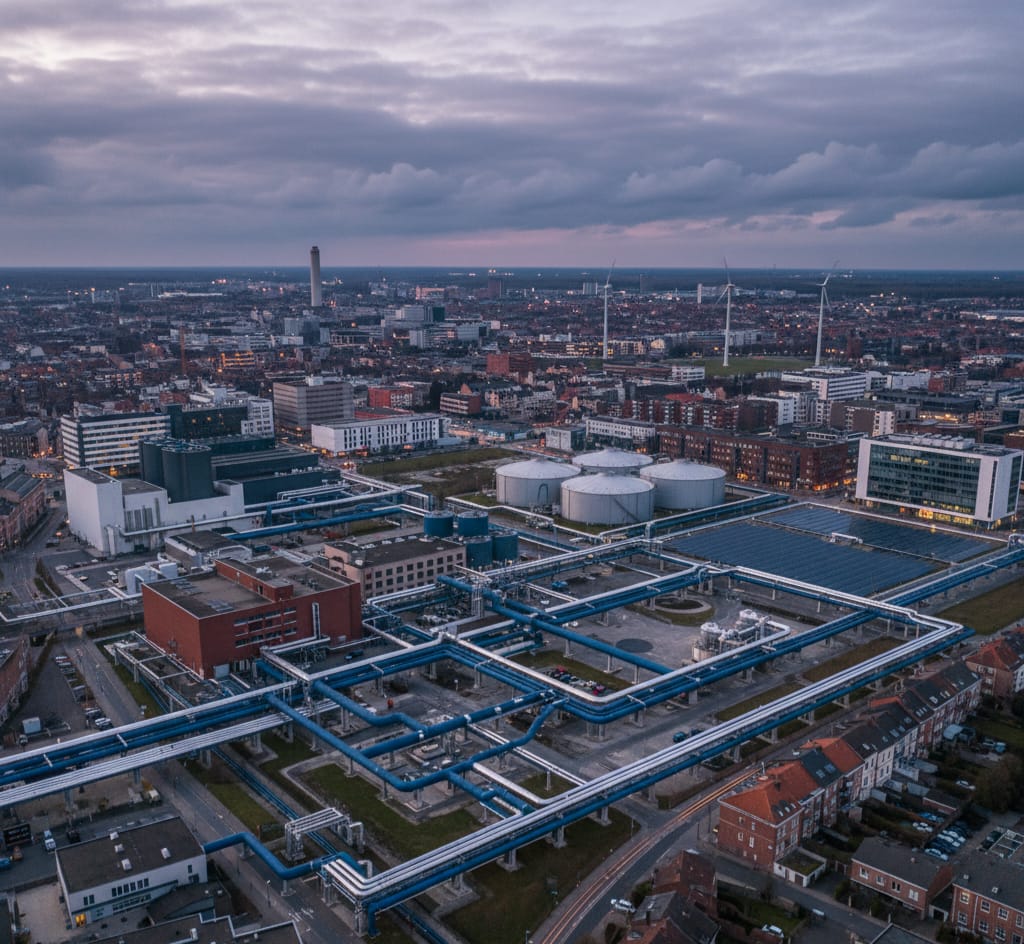
The role of industrial refrigeration in the energy resilience of Belgian cities: thermal storage and district cooling networks
/0 Comments/in blog /by webdono19In a context where energy demand is increasing, climate transition is accelerating, and the efficiency of urban infrastructure is becoming crucial, industrial refrigeration in the energy resilience of Belgian cities emerges as a major strategic issue. In Belgium, with high urban density and growing cooling needs in the tertiary, industrial, and residential sectors, the development of high-performance cooling solutions is profoundly transforming urban energy management. Specialized companies like Frigotec, active throughout Belgium, are supporting this transition by deploying innovative and sustainable technologies, adapted to European requirements.
A changing Belgian energy landscape
In recent years, Belgian cities have faced several challenges: more frequent heatwaves, increasing energy consumption in buildings, network saturation, and the need to reduce carbon footprint. In this context, industrial refrigeration in the energy resilience of Belgian cities gains significant importance.
Cooling needs are increasing in essential sectors: hospitals, data centers, shopping centers, supermarkets, agri-food industries, and public infrastructure. However, cooling itself is a significant energy consumer. Belgium must therefore develop solutions to stabilize networks, better manage consumption, and ensure a sustainable supply of cooling. This is where industrial refrigeration in the energy resilience of Belgian cities becomes an essential pillar of urban energy strategy.
Understanding the Role of Industrial Refrigeration in Energy Resilience
To understand how industrial refrigeration in the energy resilience of Belgian cities concretely contributes to energy efficiency and security, its contribution must be analyzed at three levels:
- stabilization of electricity grids,
- optimization of energy consumption,
- strengthening supply security.
A. Electricity Grid Stabilization
Traditional cooling systems place significant strain on the electricity grid during hot periods, causing consumption peaks that can lead to overload, outages, and increased electricity costs.
industrial refrigeration in the energy resilience of Belgian cities, combined with thermal storage, allows for the production of cooling during the night, when electricity is cheaper and networks are less strained. This cooling is then used during the day, smoothing consumption peaks and strengthening grid stability.
B. Optimization of Energy Consumption
industrial refrigeration in the energy resilience of Belgian cities also plays a key role in optimizing installations. Modern technologies, such as high-efficiency compressors, natural refrigerants, and connected systems offered by Frigotec, enable:
- improving the performance of compressors,
- efficiently managing cooling distribution,
- anticipating needs through smart management.
These innovations concretely demonstrate the impact of industrial refrigeration in the energy resilience of Belgian cities on cost reduction and improved demand management.
C. Enhanced Supply Security
Thermal storage ensures a reserve of cold energy. Thus, in case of high demand or power failure, installations continue to operate, a vital element for:
- hospitals,
- laboratories,
- data centers,
- the pharmaceutical industry,
- supermarkets and cold storage warehouses.
Further proof of the importance of industrial refrigeration in the energy resilience of Belgian cities.
Thermal Storage: A Key Technology
Thermal storage is at the heart of industrial refrigeration in the energy resilience of Belgian cities. Several methods exist, each strengthening energy resilience:
A. Ice Storage
It allows for the production of ice during off-peak hours and its subsequent use to cool circuit water or directly supply cooling systems.
Advantages:
- high energy capacity,
- cost reduction,
- reduction of electricity peaks.
Frigotec regularly installs this type of system in hospitals, shopping centers, and industrial buildings.
B. Chilled Water Storage
Easy to integrate into infrastructure, the chilled water tank offers homogeneous cooling distribution, actively contributing to industrial refrigeration in the energy resilience of Belgian cities.
C. Phase Change Materials
These materials store cold by transitioning from a liquid to a solid state. Highly efficient and compact, they effectively anticipate temperature variations and strengthen cities’ capacity to manage energy demand.
Urban District Cooling Networks
Another major component of industrial refrigeration in the energy resilience of Belgian cities, urban district cooling networks function like an inverted heating network. A central plant produces cooling, which is then distributed to several buildings via a chilled water network.
A. Advantages
- reduction of individual consumption,
- elimination of noisy units,
- pooling of production,
- enhanced energy security,
- strengthened sustainability.
B. Integration of Renewable Energies
These networks can utilize industrial waste heat or renewable energies (geothermal, solar thermal), demonstrating that industrial refrigeration in the energy resilience of Belgian cities goes beyond a simple cooling function.
C. Frigotec’s Expertise
Frigotec supports the design, installation, and maintenance of urban networks, ensuring reliability and performance, while optimizing industrial refrigeration in the energy resilience of Belgian cities.
Concrete Applications
A. Hospitals
Thermal storage reduces grid dependency and ensures constant cooling for operating theaters, pharmacies, servers, and patient rooms.
B. Data Centers
These highly energy-intensive centers directly benefit from district cooling networks and thermal storage to optimize their consumption.
C. Supermarkets and Food Industries
Frigotec’s solutions, integrating low-consumption display cases and natural refrigerants, enhance energy stability while reducing costs.
Carbon Footprint Reduction
Energy efficiency, peak optimization, and the use of natural refrigerants enable industrial refrigeration in the energy resilience of Belgian cities to contribute to national and European climate objectives.
Technological Innovations
Artificial intelligence, hybrid systems, predictive maintenance, and smart meters further enhance the impact of industrial refrigeration in the energy resilience of Belgian cities, providing cities with more resilient and sustainable infrastructure.
Maintenance and Expertise
The durability of installations relies on rigorous maintenance. Frigotec ensures monitoring, compressor control, energy efficiency, and regulatory compliance, thereby guaranteeing the long-term success of industrial refrigeration in the energy resilience of Belgian cities.
Facing energy challenges, industrial refrigeration in the energy resilience of Belgian cities stands as a central pillar of the energy transition. Between thermal storage, urban district cooling networks, and technological innovations, Belgian cities now have robust and sustainable solutions to meet current and future challenges, with Frigotec‘s expertise as an indispensable partner.


Leave a Reply
Want to join the discussion?Feel free to contribute!